
If you’re in sales, you know that it’s a numbers game. The more activities you perform, the better your results will be.
That’s why at BDU one of the first things we do when we start working with a client is to help them build out a strong, well-defined game plan. Together, we identify the activities that will drive their results and establish goals that keep their salespeople focused.
One area that’s important to evaluate is their client visit strategy and how they’re managing their existing business. From the beginning, we want to know how often they are meeting with their clients and if those visits are creating opportunities.
Why? Because in sales, your clients are your gold.
They aren’t just people you’re providing with your products or services. They’re one of your greatest sources of future business. They can lead to referrals, references, upselling opportunities, cross-selling opportunities and introductions to new decision-makers. They can also provide insight into what’s happening inside their organization before anyone else knows about it.
The challenge isn’t recognizing that your clients are valuable. The challenge is knowing where to start and how to develop your client visit strategy.
What Is a Client Visit Strategy?
A client visit strategy is a structured plan for deciding which clients to visit, how often you should meet with them and what you hope to accomplish during each interaction. Rather than reacting only when there’s a project to work on or a problem to address, a strong client visit strategy ensures you’re consistently strengthening relationships, uncovering new opportunities and staying top of mind.
A Client Visit Strategy Lesson from the Field
Recently, BDU’s CEO Lisa Peskin was working with one of her clients to help improve their sales and business development process.
The company was working on developing goals for increasing client visits. They wanted to begin scheduling more quarterly reviews, holding more strategic meetings and spending more time strengthening client relationships.
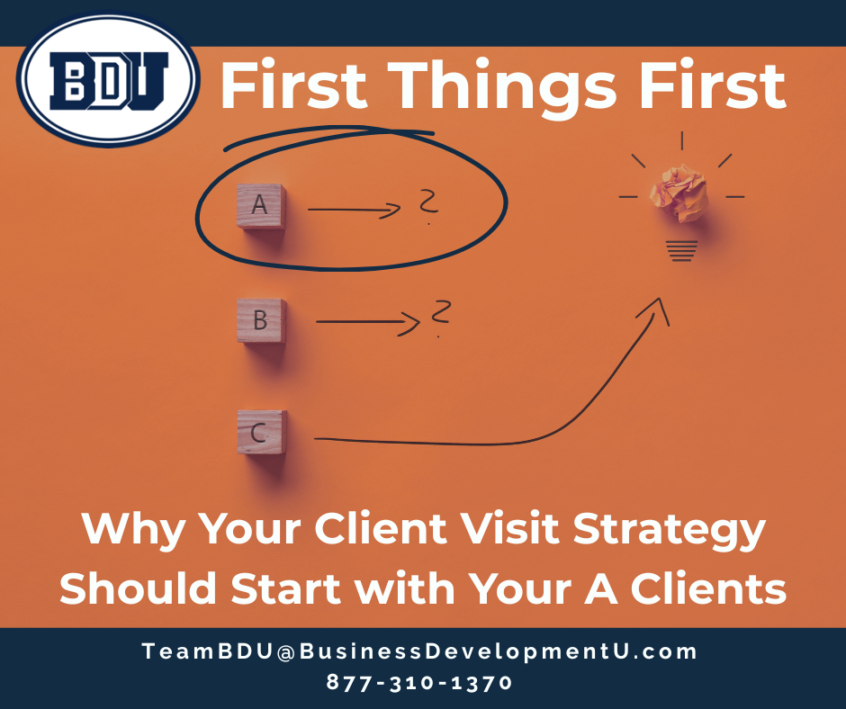
As Lisa reviewed their plan, she noticed that instead of working on meeting with all of their clients simultaneously, they decided to focus on completing visits with just their A-tier clients first. Once those meetings were complete and the next meetings were already scheduled, they would only then move on to their B-level clients.
It was an “aha!” moment for both Lisa and her client, and a great example of why you should always put first things first.
Why Your A Clients Should Come First
Think about your own client list. Not every client contributes equally to your business.
Your A clients are typically the organizations that:
- Generate your highest revenue
- Have the greatest potential for future growth
- Have been loyal clients for years
- Trust your team and value your expertise
- Have referred business in the past
- Are likely to introduce you to other decision-makers
- Represent a significant share of your business
Let’s say your client portfolio includes:
- 12 A clients
- 20 B clients
Try working sequentially. Meet with all 12 A clients first. As you finish each meeting, schedule the next one before you leave (as we always recommend, set the next step at the current step to save yourself a step!).
Only after you’ve completed your A client visits should you begin working through your B clients, and so on.
Your time is your most valuable resource and your A clients offer the greatest opportunity to generate meaningful business results.
What Makes an A Client?
Every company defines A clients a little differently, but there are several common characteristics.
They may be your:
- Highest revenue accounts
- Largest customers
- Longest-standing relationships
- Clients with the greatest growth potential
- Accounts with the highest share of wallet
- Organizations that regularly provide referrals
- Strategic accounts that influence your reputation in the marketplace
You may also classify clients based on:
- Industry
- Geographic territory
- Company size
- Percentage of your overall revenue
- Future business potential
The important thing isn’t the exact criteria. Instead, it’s making a conscious decision about which clients deserve your attention first.
Build a Client Visit Strategy That Delivers Results
Once you’ve identified your A clients, the next step is creating a client visit strategy that helps you stay focused, consistent and intentional.
A strong strategy isn’t just about getting meetings on the calendar. It’s about making sure you’re investing your time where it will have the greatest impact.
- Prioritize Your A Clients
Don’t fall into the trap of working on A and B clients at the same time. Complete your A client visits first, then move on to your B clients. Before you leave each meeting, schedule the next one to save yourself a step and help ensure your most important relationships don’t fall through the cracks.
- Determine Your Visit Cadence
Decide how often you should meet with each client segment. Your A clients should have the most frequent, proactive touchpoints, whether that’s monthly, quarterly or another cadence that fits your business. The key is to be intentional instead of just waiting until there’s a project or issue to discuss.
- Plan Every Conversation
Every client visit should have a purpose. Go beyond the task at hand and look for ways to strengthen the relationship. Discuss upcoming initiatives, ask about future goals, identify opportunities to expand your business, request referrals and explore introductions to other decision-makers within the organization. The more intentional your conversations are, the more value you’ll uncover.
- Measure Your Success
Like every other sales activity, your client visit strategy should include measurable goals. Track metrics such as the number of A client visits completed, referrals generated, additional revenue uncovered, Blue Sky Meetings held and follow-up meetings scheduled. Measuring your results helps you stay accountable and ensures your client visits produce meaningful business outcomes.
Every Client Visit Needs a Purpose
One mistake we see all the time is treating client visits as project meetings. You stop by because there’s an order to review, a problem to solve or a contract to discuss.
While those meetings are necessary, they’re just not enough.
Every client visit should have a purpose beyond just today’s transaction. Your A clients deserve proactive conversations that strengthen the relationship and uncover future opportunities.
That’s where strategic meetings like quarterly business reviews and Blue Sky Meetings become so valuable. These conversations focus on the future instead of the task at hand.
They allow you to ask questions like:
- What are your biggest business priorities this year?
- What challenges are you anticipating?
- What initiatives are coming up?
- Where are you hoping to grow?
- How can we support your business in additional ways?
- Is there anyone else in your organization we should be meeting?
These conversations often uncover opportunities that might never come up during a routine project meeting.
Want a tool to help guide your next client visit? We’ve got one for you! Check out our Client Visit Checklist in our BDUtensils library now.
Squeeze the Lemon
At BDU, we believe in our philosophy of squeezing the lemon, or getting the most “juice” out of each and every activity you do.
Every client relationship has more potential than most salespeople realize.
During every A client meeting, look for opportunities to:
- Retain and strengthen the relationship
- Generate referrals and references
- Identify upselling opportunities
- Explore cross-selling opportunities
- Expand into additional departments
- Meet higher-level decision-makers
- Learn about future projects
- Become a trusted business advisor instead of simply a vendor
When you consistently approach client meetings this way, you’re maximizing the value of every relationship.
Make Sure You’re Talking to the Right People
Many salespeople spend years working with the same contact. While that’s comfortable, it can also limit your opportunities.
Use your A client meetings to broaden your network. For example:
- If you’ve primarily worked with the purchasing department, ask to meet operations.
- If your relationship has been with sales, look for opportunities to connect with finance or executive leadership.
The more relationships you build within an organization, the more valuable and secure your partnership becomes.
Measure What Matters
Like every other part of your sales process, client relationship management should include measurable goals.
Consider tracking:
- Number of A client visits completed
- Number of quarterly business reviews conducted
- Number of Blue Sky Meetings held
- Referrals generated
- References secured
- Additional revenue from existing clients
- Upsell opportunities identified
- Cross-sell opportunities identified
- New decision-makers introduced
- Follow-up meetings scheduled before leaving each client
These metrics help ensure your client strategy remains proactive instead of reactive.
Frequently Asked Questions
What are A, B and C clients?
A, B and C client segmentation is a way to prioritize your customer base. A clients are your highest-value accounts based on factors like revenue, growth potential, strategic importance or long-term relationship. B clients have strong potential and C clients typically require less proactive attention.
Why should I prioritize A clients first?
Your A clients often represent your greatest opportunity for additional revenue, referrals and long-term growth. By focusing on them first, you maximize your return on the time you invest in client relationship management.
How often should I visit my A clients?
The right cadence depends on your business, but your A clients should have a consistent schedule for relationship-building meetings, such as quarterly business reviews, Blue Sky Meetings or strategic planning sessions. Don’t wait until there’s a problem to reach out. Be proactive!
What should I accomplish during a client visit?
A successful client visit should strengthen the relationship while uncovering opportunities for referrals, additional business, cross-selling, upselling and introductions to other stakeholders. Every meeting should have a clear objective. Check out BDU’s Client Visit Checklist in our BDUtensils library for a free downloadable tool to help guide your conversations.
What is a Blue Sky Meeting?
A Blue Sky Meeting is a proactive conversation focused on the future of the client’s business rather than the immediate project at hand. It’s an opportunity to discuss long-term goals, challenges, new initiatives and ways to deepen the partnership.
The Bottom Line
One of the biggest mistakes sales professionals make isn’t neglecting their clients. It’s trying to give every client the same level of attention right away.
Your best opportunities deserve your attention first, so make sure to:
- Identify your A clients.
- Create a consistent cadence for visiting them.
- Have meaningful conversations that go beyond the project at hand.
- Ask thoughtful questions.
- Look for referrals, expansion opportunities and new relationships within the organization.
- Most importantly, finish meeting with your A clients before moving on to your B clients.
Focus your time where it will have the greatest impact, and don’t treat every account the same. Build a client visit strategy that puts your A clients first, meet with them consistently and have meaningful conversations to make every visit count.
When you focus on your biggest opportunities before moving to the next tier, you’ll get much more out of your client visits by uncovering more referrals, more opportunities, more revenue and stronger relationships.
BDUtensil Tip: Before your next A client meeting, make sure to download BDU’s Client Visit Checklist from the BDUtensils Library. It will help you prepare thoughtful questions, uncover additional opportunities and make every client conversation count!